
3 Keys to Trust Accounting and Reporting

Managing the accounting of trusts can be complex. There are a variety of ways in which trusts can be established, and the rules and regulations of trust accounting vary by state. To simplify, trust accounting is essentially the tracking and bookkeeping of cash in various accounts. Anneke Stender, the EVP of Plumb Bill Pay and Family Office Accounting, likens it to one big bank reconciliation.

  1. Background on the Basics of Trust Accounts

An account in trust (or trust account) refers to any type of financial account that is opened by an individual and managed by a designated trustee for the benefit of a third party per agreed-upon terms.

Trust assets are generally either “principal” or “income” where the principal is the assets owned by the trust, and the income is what is earned by those assets. Assets in a trust can be anything from cash, stocks, bonds, privately held companies to real estate holdings.

  1. Trust Accounting Main Concerns

It is imperative that the allocation of income versus principal is both accurate and accurately reported to maintain the integrity of the trust. The beneficiaries of the trust need to know what funds were allocated and to whom. This helps to ensure that the beneficiaries receive their fair share of the allocation, and it also reduces the risk of disputes.

To further eliminate the likelihood of arguments or disagreements over trust allocations, many trust reports will be filed by an attorney with the court.

One other challenge of Trust Accounts is that not all of them are protected from creditors. Typically, an irrevocable trust protects assets from creditors whereas a revocable living trust does not. However, the protection of an irrevocable trust varies depending on the state. It is highly recommended that you reach out to an attorney who is experienced in this field with specific questions about protections.

  1. Benefits of Trust Accounts

There are tremendous benefits to setting up Trust Accounts, and these tend to outweigh any of the downside. Among these benefits are:

  • Asset protection
  • Better control of those assets
  • An equitable division of assets among family members/beneficiaries

Another notable benefit of trust accounts is the avoidance of probate. When assets are held in trust, beneficiaries typically bypass the probate process in the event of the account holder’s death. Additionally, trusts provide a means to reduce or even eliminate substantial estate taxes. By transferring assets into trusts, individuals can effectively decrease their overall taxable estate.

Maintaining a trust is relatively straightforward for both beneficiaries and other involved parties, especially with a knowledgeable team that understands state regulations and the trust’s objectives.

As expert accountants for high-net-worth individuals and families, Plumb has decades of experience preparing the accounting for trusts. This includes:

  • Managing the books on a monthly, quarterly, and annual basis.
  • Working with the trustee in processing payments to vendors and beneficiaries.
  • Allocating income and principal funds.
  • Providing necessary reports for the attorneys, CPAs, trust beneficiaries or the court.
  • Preparation of annual court accountings

There is specialized accounting that is required for trusts, and the rules and regulations vary by state, so it is important to understand the specific requirements of your state.

For those unfamiliar with the specific accounting requirements of trusts, consulting with expert accountants and attorneys who specialize in this area is strongly advised. They can help manage the books, make accurate allocations, and provide the necessary reporting – essentially making the complex straightforward. Whether you are a beneficiary, a trustee, or someone considering setting up a trust, arming yourself with knowledge and a proficient team can help you optimize the advantages that trusts offer.

Why – and How – to Track Monthly Spending for High-Net-Worth Individuals

Tracking monthly spending has numerous benefits for individuals across all tax brackets. For high-net-worth individuals (HNWI), it is particularly crucial due to their often complex financial portfolios and diverse spending patterns. These complexities can make it challenging to fully understand cash outflows and pinpoint where money is going each month. Without clear insight into their expenditures, managing and preserving wealth becomes more difficult. This highlights just one of the many advantages of consistently tracking monthly spending.

Tracking expenditures for HNWI has 5 main advantages:

  1. Leads to more mindful spending.

Access to monthly spending data provides a clear picture of spending habits, including both regular and irregular expenses. This information helps to identify areas where expenses can be reduced or streamlined, ultimately leading to better financial management.

  1. Identifies problem areas and where there might be overspending.

Tracking monthly spending provides a comprehensive view of one’s finances, making it easier to create an accurate budget. This can help high-net-worth individuals allocate their funds effectively and avoid overspending in one area while underfunding in another.

  1. Assists with better planning for major expenses.

High-net-worth individuals often have significant expenses like buying a vacation home, a yacht, artwork, or other high-value items. Tracking monthly spending can provide the information needed to plan for these major expenses, helping to ensure that there are enough funds available when the time comes.

  1. Provides increased awareness of investment opportunities.

By tracking monthly spending, high-net-worth individuals can identify areas where they have excess funds. This excess can then be invested in various opportunities that can lead to financial growth and stability.

  1. Improves cash flow management.

By keeping track of monthly spending, high-net-worth individuals can ensure that their cash flow remains positive. This helps them to avoid being caught in financial difficulties and maintain their wealth.

Best Way to Track Monthly Spending

There are clear benefits to tracking monthly spending. But what is the best way to do so? For high-net-worth individuals, we recommend outsourcing this task to experts (like us).

Why? That’s easy – it’s because we are solely focused on providing outsourced bill pay and accounting services to high-net-worth individuals and families. We’ve been dedicated to supporting these clients for decades, and we have a depth and breadth of knowledge that makes us true experts.

Plumb’s Outsourced Bill Pay Services

Outsourced bill pay service providers like Plumb offer monthly reconciliations to keep track of all transactions. Additionally, we provide easily accessible reporting to highlight the current state and future projections of cash outflow.

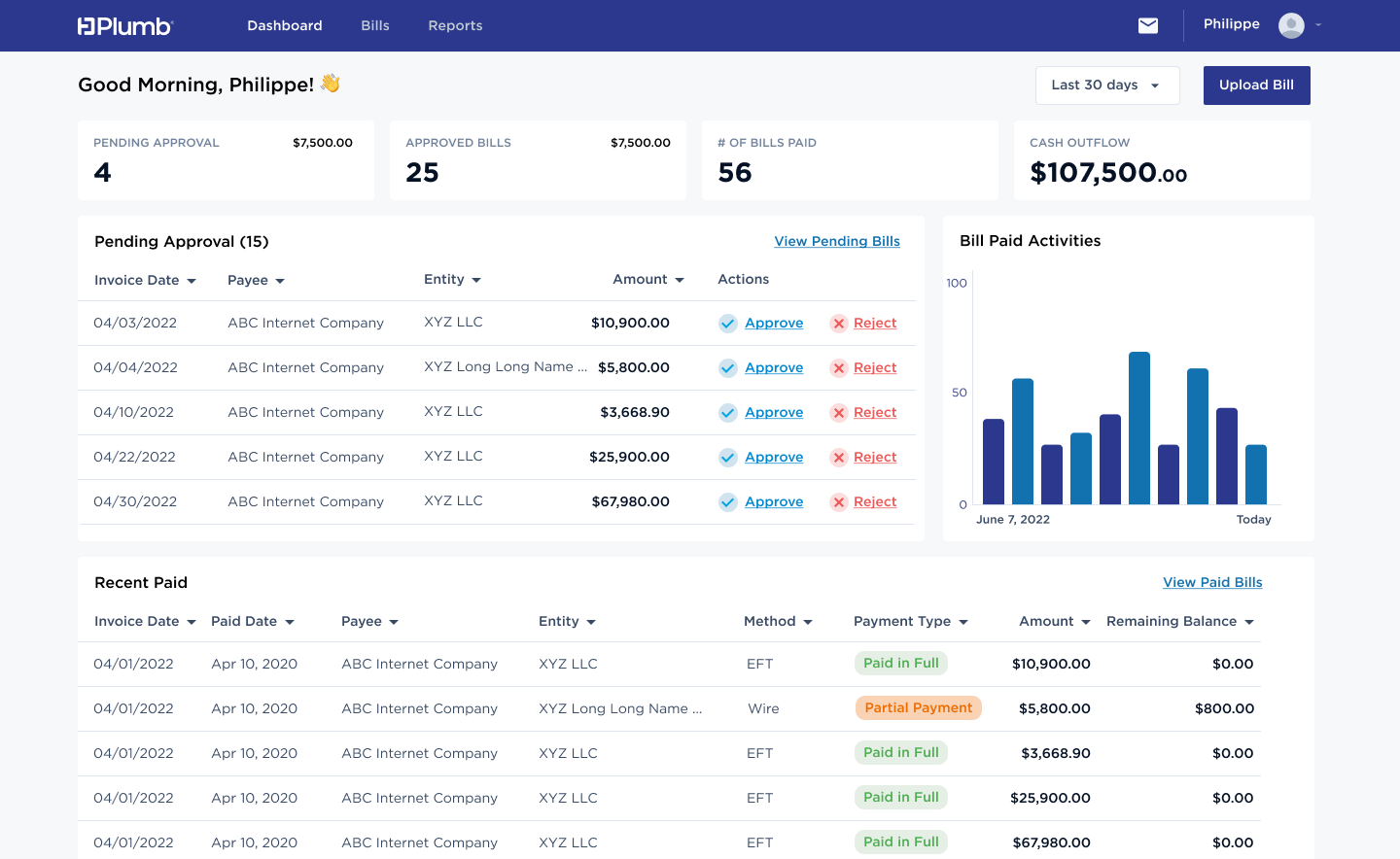
Plumb has also developed a proprietary bill pay app specifically designed for our clients and their financial advisors. This app streamlines the entire bill pay process and makes approving bills, viewing bill payment status, and communicating with the Plumb team easier than ever. It provides the clarity we know these clients need as well as access from anywhere, at any time we know they want.

Plumb’s Proven Process

At Plumb, we have a proven process in place for assisting our high-net-worth clients track their monthly spending:

Goal Tracking

  • We provide quantifiable information to help them meet the goals they’ve established.

Software Tool Assessment

  • We also make recommendations about the best software for them to utilize. For example, clients with multiple entities are best served by a software suite like Sage Intacct, whereas clients with more straightforward finances can use a platform like QuickBooks Online. Both are excellent tools, both can help to streamline reporting and create efficiencies, but it ultimately comes down to the clients’ specific needs.

Customized Reporting

  • When it comes to reporting, Plumb offers fully customizable reports. We provide P&L’s, expense tracking reports, cash flow statements, income statements, balance sheets, and more robust investment tracking reports offered by our Family Office Accounting team.

Supportive Services

  • We work in partnership with the wealth advisors of our clients, as well as directly with the client – whatever they prefer. Our goal is to make sure we are providing our clients with everything they want and need in their expense tracking.

Tracking monthly spending is a crucial aspect of personal finance, especially for high-net-worth individuals. With a considerable amount of wealth, monitoring how money is being spent is essential to making sure that they are on the right path towards realizing their goals and long-term wealth preservation. Outsourced bill pay and accounting service providers like Plumb are here to help ensure they have clarity into their daily finances so they can go out and enjoy what matters most to them.

Plumb Shortlisted for 3 Awards


We are thrilled to be recognized by two different organizations for our contributions to the family office accounting and bill pay space this year.

Plumb has been shortlisted for the Technology Innovator of the Year Award at Citywealth’s Magic Circle Awards – and you can vote for us by visiting this link.

We’ve also been shortlisted for the Best General Ledger System and the Best Partnership Accounting System at the Private Asset Management (PAM) Awards. We appreciate this acknowledgement from both Citywealth and PAM.

This recognition comes on the heels of a year of tremendous growth for Plumb Family Office Accounting & Bill Pay, and the development of our proprietary bill pay app. We are in great company as our fellow shortlisted firms are the best in the business, and we wish them all the luck.

We are grateful to our clients, our partners in wealth management, and our incredible Plumb team.

The Wealth Mosaic Interviews Anneke Stender

Great interview with Plumb Family Office Accounting & Bill Pay EVP and Co-Founder Anneke Stender featured on The Wealth Mosaic.

In this series, The Wealth Mosaic (TWM) interviews leading members of the wealth management and FinTech communities to find out more about them, their journey, their perspectives on the market and how they see the future.

Read Anneke’s interview here.


Plumb Family Office Accounting is an expert at delivering the clarity and financial peace of mind high-net-worth individuals and family offices need. Let us know if you would like to get in touch for more information. We work in partnership with your team — wealth, CPA, and other advisors — to provide the highest quality financial reporting. This gives you true control of your wealth and establishes the foundation for effectively implementing your financial strategies.


How Can I See Where My Cash is Going Each Month?

Having clarity regarding your monthly spending and cash outflow provides not only important insights that can help you make smarter, more informed decisions but also the peace of mind knowing that your finances are in order.  


We outline below some pivotal steps you can take to ensure you understand where your cash goes every month. 

We all know that tracking your monthly personal and business expenses is very important, yet it can be a surprisingly difficult task when your finances are complex and you have a lot to manage.


Staying informed becomes even more challenging when you own multiple properties, businesses, investments, or other assets. As your personal finances grow, the maintenance required changes and intensifies. Not knowing where you stand every month related to your expenses can generate stress and hinder your growth plans – or can potentially force you to make poor decisions. Understanding clearly how your money is being spent allows you to correct course if and when needed, so you can continue to move in the right direction.  


A comprehensive monthly report is the tool you need to help you gain clarity into your monthly finances. Like a rearview mirror that prevents blind spots, a monthly report will give you perspective on your positioning. Often the first few monthly reports can be a sobering experience, even for those who feel they generally have a good hold on their finances, but do not worry. With these new insights you can make any of the necessary changes to get yourself back on track. One important note: make sure your monthly report categorizes your expenses so you can get a good feel about where to cut back and where to allocate more resources.  


A monthly cash report allows you to compare your spending month to month and year to year. Plumb Family Office Accounting tracks against expense categories and sums up the over/under variance, focusing on year-to-date changes. Having this report allows for more efficient meetings with financial planners. At Plumb we use the latest software to provide you with all views and angles of your spending so you can see the whole picture. 


When you work with Plumb, we make sure every deduction in your spending is accounted for, which makes filing taxes significantly easier. Accessible monthly cash flow reports let you keep tabs on your finances, so you and your financial team can make better decisions together.  

Plumb Family Office Accounting is an expert at delivering the clarity and financial peace of mind high-net-worth individuals and family offices need. Let us know if you would like to get in touch for more information. We work in partnership with your team — wealth, CPA, and other advisors — to provide the highest quality financial reporting. This gives you true control of your wealth and establishes the foundation for effectively implementing your financial strategies.


5 Ways Plumb Addresses Capital Call Challenges

Our clients often ask us how we can help them manage capital calls and alternative investments. Our years of experience working with investors and ultra-high-net-worth individuals has allowed us to create best practices for a seamless, secure, and transparent process. 

In years past, the timing of capital calls used to be more clearly scheduled and defined, but we have noticed a recent change: capital calls are no longer always scheduled out in advance, but rather they are being made when a fund has the need and/or finds a new investment. This trend results in an even greater need to understand the nuances of a capital call, and to have a clear and safe process in place to address them. 

Below we have outlined some of the ways in which we alleviate the administrative burden and stress of capital calls while providing clarity, organization, and security around this pivotal piece of investing. 


1. Plumb assists clients with completing Subscription Agreements. 

The first step in investing is often the required completion of a Subscription Agreement. These can be lengthy and somewhat tedious forms to complete, but they are a necessary part of investing in a Limited Partnership. We perform this important administrative service for our clients, so they can focus on the big picture. All they need to do is review it and sign. 


2. We are proactive in the management of capital calls to ensure our clients are never in breach of contract. 

Many of our clients are investors across myriad funds and banks, which can make staying on top of portals, notifications, and deadlines extremely challenging. We create organization around this process. We have access to all the necessary portals so that we can receive and verify all notifications and issue payments on time. Whether our clients’ financial advisors are managing the fund or not, Plumb will track, manage, and issue payments for any and all capital calls. 


3. Plumb has a strict and critical wire approval and verification process. 

In this age of wire fraud and digital hackers, Plumb has created a best-in-class and hyper-vigilant wire approval and verification process. Our approach gives our clients, their financial advisors, and the funds in which they have invested the peace of mind needed so they can put their focus and energy elsewhere.  


4. We provide transparent commitment tracking. 

We understand that it can be difficult to track how much money has been paid out and how much might still be owed. We provide our clients with clear and transparent reports that demonstrate precisely how much of their commitments have been met, and what they still will be called upon to pay so they can plan accordingly. 


5. Plumb collects, documents, and organizes all necessary K1 forms. 

Another critical function of Plumb is to gather and organize the K1 forms for our clients at the end of the year. These forms are often difficult to collect, especially when dealing with varied investments and investment portals. We ensure that all K1 forms are received and shared with the CPAs of our clients in advance of tax season. 


At the end of the day, Plumb shines when it comes to managing the administrative and transactional function of capital calls. We are experts in the due diligence and organization necessary to ensure that our clients respond to their capital calls in a timely and secure manner. 

Plumb Family Office Accounting delivers financial peace of mind by assisting high-net-worth individuals and family offices know where your money is going, so your trusted advisors can effectively manage it. We work in partnership with your team — including wealth, CPA, and other advisors — to provide the highest quality of data and financial reporting to establish a holistic view of your assets and financial holdings. This gives you true control of your wealth and establishes the foundation for effectively implementing your financial strategies. Please let us know how we can help you or your clients. We’d love to hear from you.

Confidentiality is King: How Plumb Protects Clients

How do you keep my information confidential?

We are often asked this question by prospective clients, and we are always happy to provide our answer because we are confident in the proven protocols we’ve established to protect our clients confidentiality.

As long-standing experts in the family office accounting and outsourced bill pay fields, and with decades of experience working with high-net-worth-individuals and family offices, Plumb understands that financial privacy and security is of paramount importance.

We proactively protect sensitive data in several vital ways.

  • We have a customized cloud network built on unique specifications, backed on a singular data center that keeps all data stored and safe from localized data loss. This data center is certified PCI 3.0 compliant, HIPAA compliant, and SSAE-16 Type II compliant.
  • We maintain state-of-the-art bank-level security and an in-house IT department that provides constant monitoring and oversight. Our vigilant IT department educates and updates our meticulous Plumb team on cyber-safety on a regular basis.
  • We have strict supervision over internal access to client information.
    • Only select designated Plumb team members have access to client records.
    • Only our Executive Team has wire and other approval rights.
  • We focus on a clear segregation of duties among our team.
    • This provides not only protection of confidentiality, but also the essential checks, balances, and oversight that only multiple reviews and sets of eyes can offer.

We pride ourselves on our effective and all-important quality controls, security measures and confidentiality guardianship. Please let us know how we can assist you in your family office accounting or bill pay needs.

Plumb Family Office Accounting delivers financial peace of mind by assisting high-net-worth individuals and family offices know where your money is going, so your trusted advisors can effectively manage it. We work in partnership with your team — including wealth, CPA, and other advisors — to provide the highest quality of data and financial reporting to establish a holistic view of your assets and financial holdings. This gives you true control of your wealth and establishes the foundation for effectively implementing your financial strategies.

(more…)

Understanding the Accounting Needs of Hedge Fund and Private Equity Investments

Hedge Funds and Private Equity Investments have a few similarities but have different end-goals.

They are similar in that they:

  • Typically appeal to high-net-worth individuals due to the high cost of entry.
  • Are often structured as limited partnerships.
  • Both pay managing partners in a similar fashion: with management fees as well as a percentage of the profits earned.

One other key similarity between the two is that the accounting of both types of investments require specialized experts who are trained and knowledgeable about the nuances involved in these complex investment platforms.

This article will explain the differences between hedge funds and private equity funds as well as the accounting requirements necessary for reporting on these investments.

First, let’s dive a little further into the definitions – and the differences between – hedge funds and private equity funds.

Hedge Funds

Hedge funds are actively managed alternative investments that use pooled money and an assortment of strategies to earn returns for their investors.

The goal of a hedge fund is to get the highest investment returns possible as quickly as possible and they are focused on short-term profits. Hedge Funds are not regulated by the SEC. These types of funds are viewed as riskier than others for a few reasons:

  • They require a significant minimum investment or net worth to participate in the fund.
  • They employ risky investment strategies and often rely on borrowed money.
  • They expect high returns in a short period of time.

business documents on office table with smart phone and digital tablet and graph financial with social network diagram and man working in the background-1

Private Equity Funds

Private equity funds are the funds used by investors to invest directly in companies. They might purchase a private company but are equally as likely to purchase stock shares of publicly traded companies. These funds are focused on long-term earning potential.

Unlike hedge funds who are only required to make a one-time investment, those who invest in private equity funds are required to invest their capital whenever called upon to do so.

Even still, private equity investments are seen as less risky than hedge funds because of their focus on long-term viability and returns. They typically seek to purchase a controlling interest in a company, and then bring on new management or provide guidance to the existing management team of that company. Their aim is to improve profitability with the ultimate goal of selling the company after their improvements have been implemented, and the increase in profits has been realized.

Hedge Fund Accounting

The accounting related to hedge funds requires the compilation of all brokerage statements that reflect on the fund. Every investment must be accounted for and included.

In addition, hedge fund accounting will help to determine the break periods. Or, in other words, the accounting helps to regulate the timing of when earnings made by the fund will be paid out to the principles and partners of the fund.

Perhaps the most important report issued by a hedge fund accountant is the NAV, or the net asset value report. This report is required once a year, and it is used to demonstrate the hedge fund performance record. It is this use that makes it such an important deliverable: it is based on these results that many investors decide where to invest. In addition, hedge fund accountants must also provide the annual income tax reports to the investors of the fund.

Working business woman with global reports and stock market change concept

Private Equity Accounting

Private equity funds must follow the standards set forth by the Financial Accounting Standards Board (FASB) and the International Accounting Standards Board (IASB). However, the operations and financial situation of the private equity fund might – and most likely will – require modifications to the accounting format of these standards. This is because these original standards were not created with private equity funds in mind.

Another important aspect to private equity accounting is an understanding of and reporting about the amount of control the fund has over an entity.

And of course, the accounting standards used by the private equity will have an impact on how and what is reported. The US GAAP (generally accepted accounting principles) differs from the UK GAAP, and both can be different from the IFRS (international financial reporting standards).

Plumb Family Office Accounting & Bill Pay has decades of experience working with both hedge fund and private equity investors. We understand the refinement, complexity, and intricacy involved in the accounting required for both investments. If you are a hedge fund or private equity investor – or a financial advisor to a client who is – please let us know if we can help.

Sources

www.wallstreetmojo.com

www.investopedia.com

www.smartcapitalmind.com

(more…)