Family offices have changed. What used to be an investment-centric operation has become a multi-disciplinary platform, one responsible for coordinating investments, operating businesses, philanthropic initiatives, real estate portfolios, governance structures, and multi-generational planning, often across multiple trusts, entities, and jurisdictions at once.
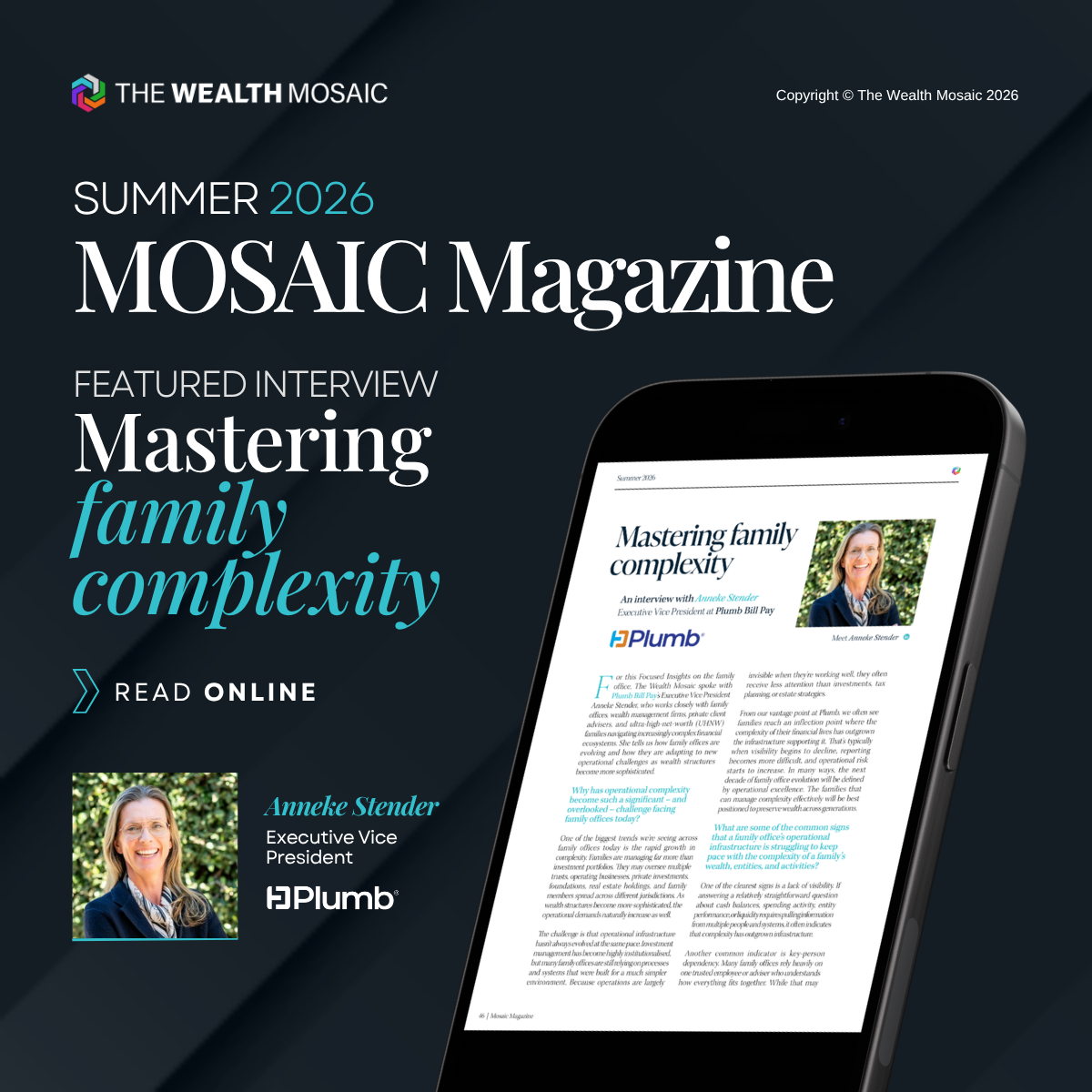
That growth in scope hasn’t always been matched by a growth in infrastructure. Anneke Stender, Executive Vice President at Plumb Bill Pay, recently sat down with The Wealth Mosaic for its Mosaic II: Summer 2026 edition to talk about why operational complexity has become one of the most overlooked challenges facing family offices today, and what the most effective family offices are doing differently.
Read the full interview in The Wealth Mosaic’s Mosaic II: Summer 2026 edition here.
The Sign That Something’s Outgrown Its Infrastructure
As family offices grow, operations tend to become invisible when they’re working well, which means they often receive less attention than investment strategy or tax planning, at least until something breaks. According to Anneke, that break rarely looks dramatic. More often, it shows up as reporting delays, a growing reliance on one person who understands how everything fits together, or a simple question about cash balances that takes longer to answer than it should.
“The first thing that typically breaks isn’t the accounting, it’s visibility,” Anneke explained.
When leadership can no longer quickly access accurate information across the family enterprise, that’s usually the clearest sign that operational processes need to evolve.
Fragmented Information, Not a Lack of It
As family offices expand across multiple trusts, foundations, partnerships, and jurisdictions, the challenge shifts. It’s no longer just about managing individual entities, it’s about managing the interdependencies between them.
“Most families don’t suffer from a lack of information,” Anneke noted. “They suffer from fragmented information.”
Data lives across multiple systems, managed by different providers, making it difficult to build a consolidated view of the family’s financial position. The risk isn’t that any single process fails. It’s that multiple disconnected processes create blind spots, in liquidity management, reporting consistency, governance oversight, and fraud prevention alike.
Governance That Enables Rather Than Restricts
There’s a common assumption that governance and personal service are in tension. Anneke sees it differently. The strongest family offices, she explained, use governance to build confidence rather than create friction. Families don’t want bureaucracy, they want to know their financial affairs are being managed accurately, securely, and consistently, without sacrificing flexibility. Well-defined approval workflows, standardized reporting, and documented controls reduce friction rather than create it. Done well, governance becomes largely invisible to the family because it operates seamlessly in the background.
Fraud Prevention Is a Governance Issue, Not Just a Technology One
That same principle extends to fraud prevention, which Anneke described as increasingly a governance issue rather than a technology issue. Most fraud events exploit weaknesses in process, approvals, and verification, not system failures. The greatest vulnerabilities tend to cluster around payment approvals, vendor management, and wire transfer requests, areas where fraudsters have become increasingly sophisticated at impersonating trusted advisors, vendors, and even family members.
The strongest controls, she noted, aren’t necessarily the most complex ones. They’re the ones applied consistently: segregation of duties, dual approval workflows, independent verification procedures, and comprehensive audit trails.
Visibility as a Strategic Advantage
Many families can see individual pieces of their financial lives clearly, Anneke explained, but far fewer can see the entire financial ecosystem at once. Improving that starts with standardization: consistent reporting frameworks, centralized data, documented processes, and integrated reporting practices.
“Visibility is not simply a reporting objective,” she said. “It is a strategic advantage.” – EVP, Anneke Stender
Preparing the Next Generation
As wealth transfers between generations, expectations are shifting too. The next generation has grown up expecting information to be immediate, digital, and accessible, and family offices need to adapt their reporting and communication accordingly. Anneke pointed to documented processes, standardized reporting, and clearly defined governance structures as ways to reduce dependence on institutional knowledge and create smoother transitions over time, noting that successful wealth transfers are ultimately about transferring responsibility and understanding, not just assets.
What Comes Next
“The next decade of family office evolution will be defined by operational excellence because the ability to manage complexity is becoming a competitive advantage.”
Looking ahead, Anneke believes the family offices that stand out over the next five years will be the ones that can scale complexity without sacrificing visibility, control, or service. Technology, including AI and automation, will play a growing role, particularly in operational areas like workflow management, cash forecasting, document processing, and anomaly detection. But technology alone won’t be enough. Strong leadership, accountability, and well-designed processes remain essential.
Read the full interview in The Wealth Mosaic’s Mosaic II: Summer 2026 edition here.